
Explainer
What is a stock?

This is not financial advice. Brewster explains the words. He does not tell you what to buy, and he does not name a price anything should hit. The full disclosures, including how a paid link is labelled, live on their own page.
A stock is a small piece of a company.
If the company is a whole sufuria of chai, a stock is one cup. You do not own the kitchen. You own a cup of whatever is in that pot. If the chai gets better, the next person may pay more for your cup. If it spills, they pay less. Some evenings there is no next person at the price you hoped for.
That cup has a grown-up name: a share. People say “stock” and “share” for the same idea. “I bought stock in the phone company” means “I bought shares in that company.”
What you actually hold
When you buy a share, you become a shareholder. You own part of the company. Usually a very small part.
Three things can come with that. None of them is a salary.
A claim on the business. If the company is sold and anything is left after the debts, shareholders share what remains. Debts get paid first. Sometimes nothing is left. Owning a share is not the same as the company owing you a refund.
A vote, on many ordinary shares. You can vote at the company’s meeting. One share is one small vote. The people with huge piles of shares have the loud voice. Your one share will not pick the chief executive, any more than one passenger picks the matatu’s route.
A dividend, only if the company pays one. A dividend is cash the company chooses to hand to shareholders out of its profits. It is not rent. It is not a promise. A company can pay one this year and skip the next. Some companies never pay one. They keep the money and try to grow.
You do not get a desk, a uniform, or a say in Tuesday’s meeting. Staff work there. You hold a record, these days usually a line in an account, that says the piece is yours.
Why a company sells shares
Sometimes a company needs money that is not a loan. A loan has to be paid back, with extra on top. Shares are a different deal. The company sells pieces of itself. Buyers hand over money. The company can use that money to open a branch, buy machines, or build the next product.
People use “listing” and “IPO” as if they were the same cup. They are neighbours. They are not the same cup.
An IPO, an initial public offering, is the first public sale of a company’s shares. Buyers pay. The company gets that money.
A listing is the exchange admitting the shares, so people can trade them there. The two often happen together. They do not have to. A company can list without selling any new shares. That is a direct listing. Shares that already exist simply start trading. The company does not raise a fresh bag of money from that step.
After a listing, shares can move from one person to another.
Here is the part that surprises people. Once the shares exist, a trade between two holders does not send cash back to the company. The cup is just changing hands. The company receives money when it sells shares itself, as in an IPO, or if it later prints new shares and sells those. A trade between people who already hold the shares does not do that.
The price is a conversation
A share price is the last price someone agreed to pay. It is not a mark from a teacher. It is not the company’s “true value” written in the sky.
Think of tomatoes at the market. In the morning a pile goes for fifty shillings. By evening, if everyone has already cooked, the same pile may go for thirty. The tomatoes did not become a different fruit. The crowd changed.
Shares move the same way. More people wanting to buy can push the price up. More people wanting to sell can pull it down. Profits, bad news, interest rates, and plain mood all join the crowd. Nobody on this site knows which way the crowd walks next. We will not give you a number to aim at.
On a chart, a stretch of time is often drawn as a candle.
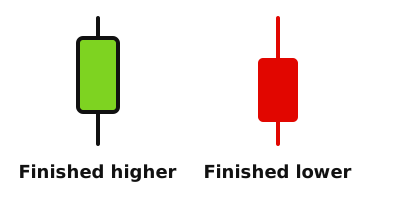
A green candle means the price finished higher than it started. A red candle means the price finished lower than it started. That is the whole personality of the candle. Green is not “good forever.” Red is not “the company died.” It is one stretch of time, up or down. Brewster cries at red candles because watching a price fall is unpleasant. Crying is not a strategy.
Where Kenyans meet shares
The main stock market in Kenya is the Nairobi Securities Exchange, the NSE. Companies list there. A broker is the business that takes your order to that market. You do not stroll onto the trading floor with a paper note. The Capital Markets Authority, the CMA, is the regulator for this world. Its job includes licensing the people who operate in the market and writing rules for how that market should behave.
Shares on the NSE are priced in Kenyan shillings and trade on market days, during the session. They do not trade at two in the morning. If an app offers you “a stock” on a Saturday night, read the label twice. It may be a different product wearing a familiar name.
A share of a company listed in another country is also a different object from a crypto token that tracks that company’s price. One is a share, with whatever rights that share has. The other is a token, and your rights are whatever the token’s paperwork actually gives you. Same headline, different thing in your hand. We will take that apart in its own explainer when it is ready. Until then, do not let the logo do the thinking.
Owning the company is not using the product
Buying shares in a phone company does not load your line with airtime. Buying shares in a bank does not open you an account. You can love a product and still lose money on the shares. You can dislike a product and watch the shares rise. The shop and the share are neighbours. They are not the same house.
Say the company is the one that sells you airtime. That is an example of the idea, not a suggestion to buy. A share is not a bundle of minutes. It is a slice of the business that sells the minutes.
What can go wrong
The price can fall, and it can stay down. Companies cut dividends. Companies issue more shares, and each old share becomes a smaller slice of the same pot. Companies fail. Shareholders can be last in the queue. You can lose the money you put in.
That is not a rare footnote. It is the deal.
If someone adds a hurry and a promise, treat that as a sales pitch. A chart with a red candle is not an insult and not a signal from Brewster. It is a picture of a price that finished lower. Pour another coffee. Read the next page when you want the words, not when someone is counting down.
A fair way to hold the idea
A stock is a slice of a business you can buy and sell. The slice can pay you, sometimes. The price is set by people trading, so it wobbles. In Kenya, the home ground for that trade is the NSE, under rules watched by the CMA.
If you remember the cup of chai, you remember enough to start reading. The next questions, like how a fund works or what a broker account really is, are separate cups. We will pour those when they have been checked, not before.
Paid links
This page does not recommend a broker. The sources underneath are public and unpaid. If a link ever pays this site, it wears a label in the sentence itself. The one in this paragraph is a fake address, so you can see the label before any real partner exists: placeholder, not a real brokerpaid link.
Sources
These are public references. They are not paid links, and they are not recommendations.
- Nairobi Securities Exchange — Kenya’s main stock exchange.
- Capital Markets Authority — The regulator for Kenya’s capital markets.